Views: 0 Author: Site Editor Publish Time: 2026-10-23 Origin: Site
Acquiring capital equipment carries incredibly high stakes for modern manufacturers. Purchasing a CNC Lathe Machine stands as a major investment for any production facility. Any miscalculation in machine capability or physical footprint directly hurts your return on investment.
Evaluating these complex machines requires an objective and structured decision process. You must move past basic marketing features to align machine specifications with your specific part complexities. Facility constraints and long-term production requirements also demand your careful scrutiny before signing a purchase order.
This guide provides a practical, vendor-neutral framework to simplify your search. We will explore exactly how to evaluate, shortlist, and validate the perfect equipment for your manufacturing goals. You will learn actionable strategies to equip your shop floor for immediate and sustainable success.
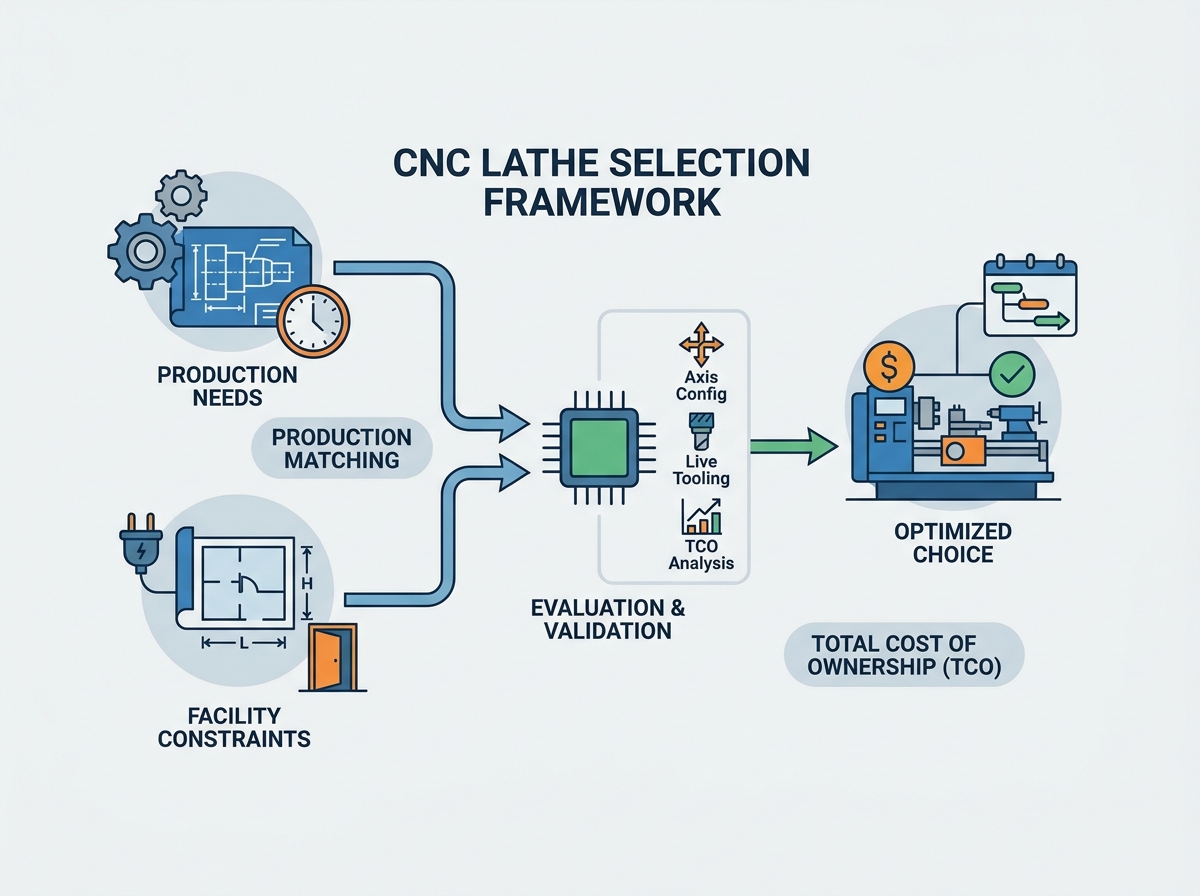
Production matching is primary: Cycle times and part complexity must dictate axis configurations and live tooling requirements, not baseline budget alone.
Facility constraints dictate viability: Power infrastructure, floor space, and rigging access are strict prerequisites before comparing machine specs.
TCO extends beyond the sticker price: Tooling, workholding, preventative maintenance, and spindle rebuilds drastically affect long-term profitability.
Validation requires proof: Never finalize procurement without a factory acceptance test (FAT) or a time-study on a benchmark part.
You cannot select the right equipment without deeply analyzing your current and future production workflows. A Precision CNC Lathe Machine must seamlessly match your shop's unique manufacturing demands. We must first evaluate the physical properties of your raw materials. Aligning spindle torque and machine rigidity is absolutely critical here. Cutting easy-machining aluminum requires vastly different specifications than turning high-temperature alloys. Materials like Inconel or aerospace-grade Titanium demand immense low-end torque. You need significant cast iron bed mass to absorb the heavy vibrations generated by tough alloys. Lighter machines will chatter, ruining surface finishes and destroying expensive cutting tools.
Next, you must clearly define your part dimensions and capacity limits. Buyers frequently focus only on the maximum turning diameter, known as the swing over the bed. However, you must also carefully evaluate the maximum turning length. Common Mistake: Failing to factor in clearance for tool changes. A long boring bar requires substantial Z-axis retraction space. If your machine bed is too short, the turret will crash into the tailstock during tool changes. Always calculate your maximum part length plus your longest tool extension.
Production volume and cycle time requirements drastically influence your ideal machine configuration. High-mix, low-volume environments prioritize rapid changeovers. In these scenarios, conversational programming controls save countless hours during setup. Conversely, low-mix, high-volume production requires continuous operation. You should prioritize automation features like bar feeders, parts catchers, and sub-spindles. These additions eliminate manual part flipping and keep the spindle running continuously.
Finally, establish your strict tolerance and repeatability needs. Determine the exact micron-level accuracy your parts require. Standard machines might hold loose tolerances easily, but aerospace or medical parts require extreme precision. Thermal stability plays a massive role in maintaining these tolerances over long shifts. As the spindle and ballscrews heat up, the metal expands. Advanced machines utilize chiller units and thermal compensation software. These features ensure your first part in the morning matches the last part of the day perfectly.
Evaluating modern CNC Lathes requires understanding how different axis configurations impact your daily throughput. Standard 2-axis setups serve as the foundation of most machine shops. They utilize an X-axis and a Z-axis. These basic machines handle standard cylindrical parts perfectly. They excel at straightforward threading, grooving, and facing operations. However, complex geometries demand multi-axis solutions. Adding a Y-axis allows for off-center milling. A C-axis provides precise spindle positioning. Sub-spindles allow machining on the back side of a part. You must evaluate the return on investment of one-and-done machining. Eliminating secondary milling operations drastically reduces your overall labor costs and setup errors.
Live tooling capabilities naturally complement multi-axis configurations. Driven tools transform a standard turning center into a versatile multitasking machine. We highly recommend assessing the necessity of live tooling for your common part families. If your turned parts require off-center drilling, tapping, or keyway milling, live tooling is essential. You can complete these features without moving the part to a separate vertical mill. This eliminates the risk of losing concentricity during part transfer. The initial cost is higher, but the resulting bottleneck reduction typically justifies the expense quickly.
The fundamental bed design represents another crucial evaluation dimension. Manufacturers typically choose between slant bed and flat bed architectures. You must compare chip evacuation efficiency, operator ergonomics, and structural rigidity. Slant beds dominate high-production environments. The angled design allows gravity to pull metal chips directly into the conveyor. This prevents heat buildup inside the cutting zone. Slant beds also allow operators to stand closer to the chuck, improving ergonomics. Flat bed designs typically serve heavy-duty applications. They accommodate massive part swings better, though chip accumulation remains a constant challenge.
Lathe Architecture Comparison Chart
Evaluation Metric | Slant Bed Architecture | Flat Bed Architecture |
|---|---|---|
Chip Evacuation | Excellent (Gravity assisted drop) | Poor (Chips accumulate on bedways) |
Structural Rigidity | Very High (Compact cast iron mass) | Moderate to High |
Operator Ergonomics | Superior (Closer reach to spindle) | Fair (Requires leaning over the bed) |
Best Application | High-volume production environments | Large diameter, heavy manual loading |
Finally, carefully evaluate control systems and CAM software integration. The best mechanical iron is useless if your programmers cannot communicate with it effectively. Ensure seamless compatibility with your existing CAM software. Popular platforms like Mastercam or Fusion360 require accurate post-processors. You must also consider operator familiarity. Fanuc, Siemens, and Haas represent the most common control interfaces. Introducing an unfamiliar control system requires extensive retraining. It will temporarily decrease your production throughput until your machinists adapt.
Before purchasing new equipment, you must conduct a rigorous physical audit of your shop floor. Ignoring facility constraints leads to disastrous installation delays. We will start with footprint and ergonomics. You must measure the total required space, not just the base machine dimensions. Look closely at the machine's footprint fully expanded. You need open-door clearance for operators. You must calculate the massive space required for bar feeder extensions. Maintenance access panels require at least three feet of clearance around the rear and sides. Cramming a machine against a wall makes routine servicing impossible.
Electrical infrastructure presents another critical hurdle. You must audit your shop's power supply thoroughly. Verify the strict requirements for 3-phase power. Industrial equipment draws massive amperage during spindle acceleration. Voltage stability is equally important. Voltage drops during heavy cuts will trigger machine alarms and ruin parts. Depending on your location, you might need a rotary phase converter. Some imported machines require dedicated step-up or step-down transformers to match local grid standards.
Effective chip management and coolant systems keep your machine running efficiently. Assess your high-pressure coolant necessities carefully. Deep-hole drilling and tough materials require coolant pressures exceeding 1000 PSI to clear chips. You must also select the correct chip conveyor style based on your material type. Hinge-style conveyors work well for stringy steel chips. Scraper conveyors handle fine cast iron or brass dust. Magnetic conveyors are ideal for ferrous materials, preventing small fines from re-entering the coolant tank.
To successfully integrate the machine, follow these numbered rigging and delivery steps:
Verify floor weight capacities: Ensure your concrete slab thickness can support the concentrated weight of the machine without cracking.
Measure all physical bottlenecks: Check doorway dimensions, hallway turns, and ceiling heights along the entire delivery path.
Hire professional riggers: Do not attempt to move heavy industrial equipment with a standard shop forklift.
Plan for leveling time: Allocate sufficient time for technicians to properly level the machine and tram the spindle before making chips.
Procuring heavy machinery involves navigating numerous hidden initial costs. You must budget for necessary add-ons rarely included in base pricing. A bare machine cannot make parts. You will need a comprehensive initial tooling package. Standard toolholders, boring bar sleeves, and collet chucks add up quickly. Custom workholding often requires significant upfront capital. Do not forget software expenses. Purchasing custom post-processors for your CAM software is mandatory for multi-axis machines. Allocate a realistic budget for these accessories to avoid production delays upon delivery.
You must rigorously evaluate the maintenance network and spare parts supply chain. Equipment breaks down eventually. When it does, your vendor's Service Level Agreement (SLA) becomes your lifeline. Investigate the local availability of certified technicians. Waiting two weeks for a technician to fly across the country is unacceptable in a production environment. Question the vendor about their average lead times for proprietary replacement parts. Reliable distributors stock critical components like ballscrews and spindle drives at local warehouses.
Warranty analysis requires careful scrutiny. Do not accept a blanket statement about a "standard warranty." You must separate the specific guarantees. Spindle warranties often carry different terms than electronic control warranties. Some manufacturers limit spindle warranties based on running hours rather than calendar months. Clarify who covers the labor costs during warranty repairs. Some contracts cover replacement parts but bill you heavily for the technician's travel and hourly rate.
Finally, ensure strict compliance with local safety regulations and industry certifications. Your new equipment must meet established CE or ISO standards. Safety cannot be an afterthought. Verify that the machine features OSHA-compliant guarding. Door interlocks must function properly to protect your operators from rotating hazards. Non-compliant machines expose your business to severe legal liabilities and hefty regulatory fines.
Your procurement process must rely on hard data, not glossy brochures. Requesting benchmark time-studies is the first step in validating a vendor's claims. Submit a complex, standard shop part to the vendor. Ask them to run a CAM simulation and provide an estimated cycle time. This exposes the true acceleration and rapid traverse capabilities of the machine. It highlights whether their control processes code fast enough for complex geometries.
Next, you must arrange physical test cuts. Never buy a machine without seeing it cut your specific material. Mandate a live demonstration. Provide your own raw material blanks if necessary. Have them run the benchmark part while you observe. Verify the surface finish with a profilometer. Check the critical dimensions to ensure the machine holds your required tolerances. This physical proof eliminates the risk of buying an underpowered machine.
Reviewing the Factory Acceptance Testing (FAT) protocols is mandatory. Establish clear performance benchmarks before the machine leaves the manufacturer's floor. The FAT must include geometric alignment tests and continuous run-time verification. You should outline exactly what constitutes a failure. Never provide final sign-off or authorize the remaining payment until the machine passes every single FAT protocol.
Evaluate your financing options and current lead times closely. Supply chain delays remain a reality in heavy equipment manufacturing. Balance the expected deployment dates with your immediate production needs. Explore equipment financing options to preserve your working capital. If applicable in your region, discuss Section 179 tax deductions with your accountant. Properly timed purchases can yield massive tax advantages, easing the financial burden of rapid expansion.
Choosing the right equipment represents a crucial exercise in risk mitigation and workflow alignment. You must look beyond standard specifications to ensure the machinery perfectly matches your unique production demands. Proper evaluation requires patience, technical scrutiny, and a clear understanding of your facility's physical limitations.
We encourage you to prioritize long-term structural rigidity and localized vendor support. Do not fall victim to aggressive base-price discounts from unproven manufacturers. A cheaper machine that suffers from frequent downtime quickly becomes the most expensive asset on your floor. Focus on measurable cycle-time improvements and reliable precision.
Take the next step in your procurement journey today. Download a standardized machine comparison checklist to organize your vendor evaluations. Alternatively, schedule a consultation with an experienced application engineer. They can review your specific part prints and recommend the exact axis configurations needed to optimize your shop's future.
A: You should choose a Swiss-style lathe when machining high-volume, small-diameter precision parts. They excel with parts possessing length-to-diameter ratios greater than 3:1. The guide bushing supports the material right at the cutting tool, preventing long, thin parts from deflecting during heavy cuts.
A: Yes, if it eliminates secondary operations. Live tooling transforms your lathe into a multitasking machine. If you currently experience bottlenecking at your milling stations after turning parts, the return on investment is typically justified rapidly through reduced labor and faster overall cycle times.
A: A quality machine boasts a baseline mechanical lifespan of 10 to 15 years. However, its precision lifespan varies greatly. Maintaining micron-level accuracy depends heavily on strict preventative maintenance schedules, avoiding severe crashes, and performing timely spindle rebuilds.
A: You should realistically budget an additional 10% to 20% of the base machine cost. This capital covers essential startup items like collet chucks, boring bar holders, cutting tools, CAM software post-processors, and high-pressure coolant upgrades required for initial production.