Views: 0 Author: Site Editor Publish Time: 2026-10-22 Origin: Site
Procuring capital equipment in manufacturing always carries high stakes. You face intense pressure to increase throughput while maintaining incredibly tight tolerances. Purchasing a modern turning system requires much more than simply looking at spindle speeds or horsepower ratings. You must align the machine's capabilities with your daily production volume. You also need to consider your specific facility constraints and your current operator expertise. Making a poor choice leads to workflow bottlenecks and wasted capital. This guide offers a systematic, vendor-agnostic framework to help you navigate this complex process. You will learn how to evaluate crucial mechanical specifications accurately. We will also show you how to mitigate common implementation risks before delivery day. By understanding these core principles, you can confidently match machine architecture to your specific application needs. You will make an informed decision supporting long-term profitability.
Application Dictates Architecture: Selecting between flat-bed, slant-bed, and multi-axis configurations relies entirely on part complexity and production volume.
Precision Requires Rigidity: True machining tolerances depend on machine mass, casting quality, and thermal stability—not just software resolution.
TCO Exceeds Sticker Price: Tooling, workholding, facility preparation, and preventative maintenance often account for 30-40% of the first-year investment.
Facility Readiness is Critical: Overlooking foundation requirements, power supply (3-phase vs. single-phase), or operator training extends the time-to-ROI.
Before looking at any specific CNC Lathe Machine, you must define your exact production goals. Clear requirements prevent you from overspending. They also prevent you from buying an underpowered machine. Building a solid specification framework guarantees better vendor discussions.
Start by evaluating your largest typical workpiece. You need to determine the maximum turning diameter. Manufacturers often call this metric the "swing over bed." You also need to know your maximum turning length. These two dimensions dictate the physical envelope of your target machine.
Next, define your spindle bore requirement. This depends entirely on the largest bar stock diameter you plan to run. If your bar stock cannot pass through the spindle, your production slows down dramatically. You will have to pre-cut material into slugs. This adds unnecessary labor and time to your workflow.
Best Practice: Always specify a spindle bore 10% larger than your current maximum bar stock. This strategy provides cost-effective future-proofing.
Common Mistake: Ignoring clearance for tooling inside the enclosure when machining parts at the maximum turning length.
Different materials demand distinct machining approaches. You must assess the required spindle torque and expected cutting forces. Aluminum allows for high-speed turning. It requires lower torque. A light-duty, high-RPM spindle handles this material perfectly.
Conversely, titanium and Inconel require high-torque, low-speed turning. These aerospace alloys generate immense cutting forces. A light-duty machine will chatter excessively. Chatter destroys tools and ruins surface finishes. If you cut hard materials, prioritize heavy castings and geared headstocks over pure spindle speed.
Your daily production mix dictates your automation requirements. You must categorize your workflow honestly.
High-mix, low-volume (HMLV): Here, you change parts frequently. You might run batches of ten or twenty pieces. Prioritize quick-change workholding systems like collet chucks. You also want intuitive conversational programming at the controller. This speeds up daily setup times.
High-volume, low-mix: Here, you run the same part for weeks. Setup time matters less than cycle time. Prioritize robust bar feeders. Add automatic parts catchers. You also need automated chip conveyors to keep the machine running unattended overnight.
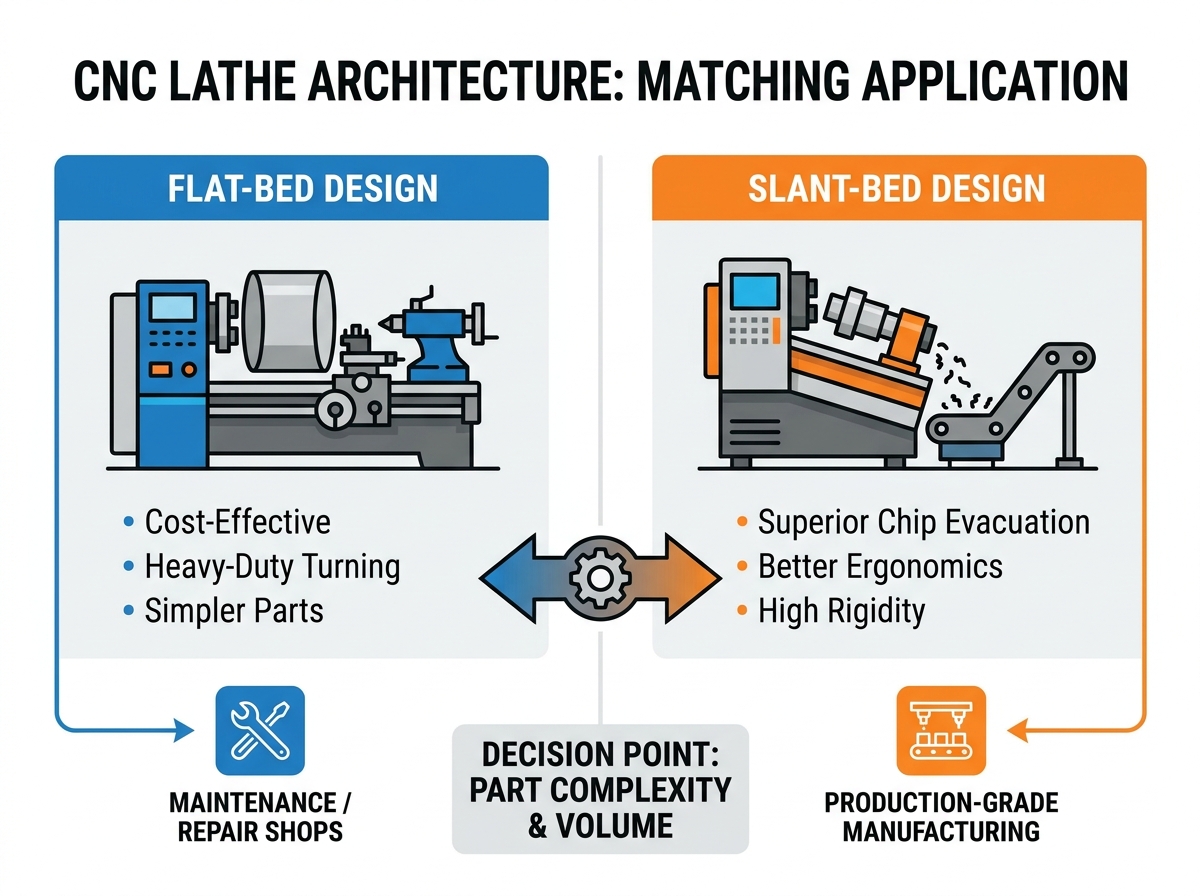
Machine architecture matters immensely. You must match the physical build to your typical applications. Different designs serve entirely different manufacturing philosophies.
These two fundamental designs exist for distinct operational reasons.
Flat-Bed designs are highly cost-effective. They work exceptionally well for heavy-duty turning. Operators use them for larger, simpler parts. Maintenance and repair shops often favor them. They offer easy, open access to the workpiece. However, chips tend to pool on the bed. Operators must clean them manually.
Slant-Bed designs represent the standard for production-grade environments. The angled bed provides superior chip evacuation. Gravity simply pulls the hot chips away from the cutting zone. This design also offers better ergonomics for the operator. Furthermore, it delivers higher structural rigidity. The cutting forces push down directly into the heavy casting.
Adding axes increases your capabilities and your costs. You must evaluate whether extra axes justify the investment for your specific CNC Lathes setup.
The standard 2-Axis configuration handles basic X and Z axis turning. It works best for symmetrical, cylindrical parts. It remains easy to program and simple to maintain.
Adding a Y-Axis and C-Axis introduces live tooling. This unlocks off-center milling capabilities. You can drill, mill, and tap in a single setup. It drastically reduces secondary part handling. However, it increases your initial cost. It also adds significant programming complexity. Your operators will need advanced CAM software training.
Sub-Spindles allow machining on the back side of a part. The machine automatically transfers the part from the main spindle to the sub-spindle. You avoid manual flipping entirely. Your cycle times drop. Your concentricity improves because human error vanishes from the part transfer process.
Selecting a Precision CNC Lathe Machine requires deep technical scrutiny. You must look past the glossy marketing brochures. True performance hides in the mechanical details.
True precision depends heavily on mass. Evaluate the base casting materials carefully. Meehanite cast iron dampens vibrations much better than welded steel structures. Heavy iron absorbs the shock of interrupted cuts.
You also need to analyze the guideways. Linear guideways utilize rolling elements. They offer faster rapid traverse rates. They significantly reduce friction. However, box ways provide superior vibration damping. Box ways feature heavy metal-on-metal sliding contact. You absolutely need box ways if your shop performs heavy, interrupted cuts on tough alloys.
Thermal stability also separates average machines from exceptional ones. Spindles generate heat. Heat causes metal to expand. Look for machines incorporating active thermal compensation. They use sensors to adjust positioning dynamically as the casting warms up.
Motion control dictates your final surface finish. Assess the ball screw quality carefully. Check the diameter and verify pre-tensioning specifications. Good pre-tensioning minimizes mechanical backlash. Backlash causes dimensional errors during direction changes.
Next, compare your spindle drive options. Direct-drive spindles produce lower vibration. They offer extreme precision and rapid acceleration. Belt-driven spindles provide easier maintenance. They also deliver higher torque multiplication for tough materials. Your material choices should drive this decision.
The control system acts as the equipment's brain. Evaluate industry-standard controllers based on current operator familiarity. Brands like FANUC, Siemens, and Haas dominate the market. Matching the new controller to your shop's existing ecosystem minimizes the training curve.
Always verify software compatibility. Your new system must communicate with your existing CAM software post-processors. It must also integrate seamlessly into your shop-floor networking protocols for data collection.
Financial planning goes far beyond the initial quote. You must break down your procurement strategy carefully. Smart sourcing prevents budget overruns.
Do not look only at the base price. You must account for essential options. Automatic tool setters save daily setup time. High-pressure coolant systems dramatically improve tool life when drilling deep holes. Chip conveyors keep the work area clean and safe.
You also need to budget for primary workholding. Hydraulic chucks, hard jaws, soft jaws, and collet systems add up quickly. Initial tooling packages represent another significant upfront cost. Buying premium carbide inserts upfront saves money long-term.
Buyers frequently debate the merits of new versus used equipment. Each path carries specific advantages and risks.
New equipment provides ultimate peace of mind. You get comprehensive warranty protection. You benefit from the latest processing speeds. You also enjoy a predictable maintenance lifespan.
Used equipment offers a significantly lower initial entry point. However, it requires rigorous mechanical inspection. You must test the ways for uneven wear. You must check ball screws using a dial indicator to measure backlash. You should measure spindle runout carefully. Finally, beware of electrical obsolescence. An outdated, unsupported controller severely limits your productivity.
Equipment Sourcing Comparison Matrix
Evaluation Criteria | New Equipment | Used Equipment |
|---|---|---|
Initial Capital Outlay | Highest premium. | Significantly discounted. |
Warranty & Support | Full factory coverage included. | Usually sold "as-is" with no backing. |
Controller Technology | Latest processing and networking. | Often slower; potential integration issues. |
Mechanical Wear | Zero wear; pristine geometries. | Requires rigorous indicator testing. |
You will face ongoing daily costs. Routine maintenance consumables drain budgets if ignored. Budget accurately for way lube, quality coolant, and replacement filters. You also need to calculate expected depreciation accurately. Finally, determine the utilization rates required to achieve profitability. A high-performance machine sitting idle damages your bottom line.
Your shop must be fully ready before the riggers arrive. Overlooking facility readiness delays your operational launch. It also creates immense frustration for your production team.
Electrical requirements catch many buyers completely off guard. Verify your power availability early. Do you have direct 3-phase power? If not, you need highly reliable phase converters. Check your breaker amperage limits against the machine's maximum draw. Running heavy cuts on insufficient amperage causes dangerous voltage drops.
You must also assess ambient temperature control. Precision machining requires a stable climate. Temperature swings destroy tight tolerances. Do not forget ventilation requirements. High-pressure coolant creates dense mist. You need proper mist extraction systems to maintain healthy air quality.
Heavy iron requires solid ground. Review the manufacturer's concrete thickness requirements. You need proper leveling. You also need vibration isolation. This proves especially critical for high-mass machinery cutting tough alloys. Standard 4-inch shop floors often crack under these loads. You may need to pour a dedicated, isolated concrete pad.
Next, calculate the true operational footprint. A machine's physical dimensions show only part of the story. You must add clearance for electrical cabinet doors. You need space for maintenance access panels. You also need ample room for bar feeders and large chip bins.
Best Practice: Tape out the exact machine footprint on your shop floor. Include all door swings and maintenance access zones.
Common Mistake: Forgetting to measure overhead door clearance before the delivery truck arrives.
Human factors often create the biggest implementation bottlenecks. Acknowledge the risk of operator resistance. Plan for dedicated post-installation training days. Do not expect your operators to learn complex new controls on the fly while hitting production quotas.
You should establish a standardized tooling library early. Create a strict preventative maintenance schedule prior to delivery. Order your cutting fluids and lubricants two weeks in advance. Thorough preparation ensures a smooth, highly profitable rollout.
The right turning equipment bridges the gap between engineering tolerances and profitable cycle times. Choosing poorly leads to scrap parts, delayed shipments, and frustrated operators. Choosing wisely builds a reliable foundation for long-term manufacturing growth.
We advise buyers to finalize a strict requirement document before engaging any vendors. Document your maximum part size, specific material types, and expected batch volumes clearly. Use this precise document to filter out inadequate proposals quickly. Finally, we highly recommend requesting a time-study from shortlisted manufacturers. Ask them to perform a test-cut on your toughest sample part. This physical test verifies their claims regarding cycle time. It also proves their mechanical capability to achieve your required surface finishes.
A: Turning centers generally feature fully enclosed guarding and automated tool changers, like turrets. They often use slant beds and incorporate live tooling for complex operations. Standard models tend to be simpler, flat-bed designs utilizing basic tool posts. Turning centers focus on high-production environments, while standard designs work well for tool rooms or simple cylindrical profiling.
A: While entry-level or desktop models can run on single-phase power, limitations exist. Industrial-grade machines require robust 3-phase power. If your facility lacks this, you must install a high-quality rotary phase converter. True 3-phase power maintains necessary spindle torque during heavy cuts. It also prevents electrical damage to sensitive servo drives and control systems.
A: You can expect a grounded lifespan of 10 to 15 years, or even longer. However, this depends entirely on strict maintenance adherence. Collision history, or crashes, severely impacts longevity. The operational environment also matters. Machining abrasive materials like cast iron accelerates wear on guideways and ball screws compared to cutting softer plastics or aluminum.