
In modern manufacturing, precision and automation are key factors that contribute to the success of production lines. One of the most widely used machines in this area is the CNC lathe. CNC (Computer Numerical Control) technology has revolutionized the way parts are produced, offering high precision, repeatability, and efficiency. If you're in the manufacturing industry, understanding how a CNC lathe works is crucial to optimizing your processes and ensuring the production of high-quality components.
At Shandong HQ Precision Technology Co., Ltd., we specialize in providing state-of-the-art CNC lathe machines and precision equipment to meet the growing demands of the industrial sector. In this article, we will explore the working principles of a CNC lathe, its components, how it differs from manual lathes, and its many advantages. Whether you're a seasoned professional or new to CNC technology, understanding these basics will give you the tools you need to maximize the benefits of your CNC lathe.
A CNC lathe is an automated machine tool used to shape and machine parts, typically by rotating the workpiece against a cutting tool. Unlike manual lathes, which require operators to control the machine's movements, CNC lathes are controlled by a computer program that dictates the movement of the tool and the workpiece.
CNC lathes are highly versatile and capable of performing various operations such as turning, drilling, boring, threading, and grooving. These machines are widely used in industries such as aerospace, automotive, medical, and electronics, where precision, repeatability, and efficiency are paramount. By automating the machining process, CNC lathes provide high accuracy and speed while reducing the likelihood of human error.
To understand how a CNC lathe works, it’s important to be familiar with its key components:
The spindle is one of the most important parts of a CNC lathe. It holds and rotates the workpiece during the machining process. The rotation speed of the spindle is controlled by the CNC system, allowing for precise cuts and operations. The spindle is typically powered by an electric motor and can rotate at varying speeds depending on the material and cutting requirements.
The tool holder is where the cutting tools are mounted. Depending on the CNC lathe, multiple tool holders may be used to perform different operations. The tool holder is connected to the turret or tool changer, allowing for easy tool changes during the machining process. Some CNC lathes have an automatic tool changer that can switch between various tools to perform a range of tasks without operator intervention.
The tailstock is used to support the workpiece at the opposite end of the spindle. It helps secure long or thin workpieces during the machining process, preventing them from bending or vibrating. The tailstock can be adjusted along the bed of the machine to accommodate different workpiece lengths.
The carriage and cross slide are responsible for moving the tool holder across the workpiece. The carriage moves along the length of the workpiece (X-axis), while the cross slide moves the tool holder in the perpendicular direction (Z-axis). These movements allow the cutting tool to perform different operations on the workpiece.
The CNC control system is the brain of the machine. It interprets the program input by the operator, which contains the instructions for the machine. The control system ensures that the cutting tools and workpiece are positioned correctly to execute each operation precisely. Modern CNC control systems offer user-friendly interfaces and can be programmed using standard coding languages like G-code.
The drive motors control the movement of the spindle, carriage, and cross slide. These motors work together with the CNC control system to position the cutting tool and workpiece with precision. The drive motors are often powered by servo motors, which provide the necessary torque and speed for the operations.
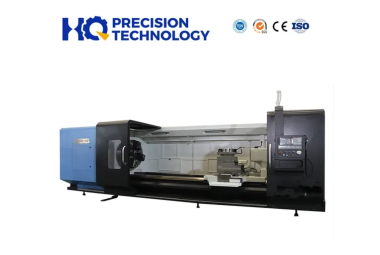
The operation of a CNC lathe is based on a simple principle: the machine rotates the workpiece while a cutting tool removes material from it. The process can be broken down into the following steps:
The first step in using a CNC lathe is creating or loading a program. This program contains a series of instructions that control the machine’s movements, including spindle speed, cutting tool selection, and the depth of cuts. The program is usually written in G-code, a standardized programming language used in CNC machining. Alternatively, the program can be created using specialized software that generates the G-code based on the part design.
Once the program is loaded, the workpiece is securely mounted onto the spindle using a chuck or collet. The tailstock may be used to support longer workpieces. The machine’s tool holder is also loaded with the appropriate cutting tools, depending on the operation required.
Once everything is set up, the CNC lathe begins the machining process. The program commands the machine to start rotating the workpiece while the cutting tool moves along the X-axis and Z-axis. As the tool moves across the workpiece, it removes material, shaping it into the desired form. The CNC system continuously monitors the operation to ensure that the correct cutting parameters are followed.
During the process, the automatic tool changer (if equipped) may change tools as needed, allowing for different operations like drilling, threading, and boring. The machine continues the process until the workpiece meets the specified dimensions and tolerances.
After the cutting process is complete, the CNC lathe will stop, and the part is removed from the spindle. The workpiece may undergo additional finishing operations like polishing or coating, depending on the requirements of the project.
One of the biggest advantages of using a CNC lathe is the high level of precision it provides. CNC lathes can create parts with tolerances as tight as a few micrometers, making them ideal for industries like aerospace and medical device manufacturing, where precision is crucial.
The automation provided by CNC lathes reduces the need for manual labor, increasing efficiency and reducing the risk of human error. Once the program is set, the machine can run autonomously, producing consistent results with minimal operator intervention.
CNC lathes are capable of performing complex machining operations, such as threading, boring, and turning. The ability to execute multiple operations with a single machine streamlines the production process, reducing the need for manual setups and minimizing downtime.
Since CNC lathes operate faster than manual lathes and require less supervision, they are ideal for high-volume production. These machines allow manufacturers to produce large quantities of parts quickly and efficiently, making them an excellent choice for industries with high production demands.
With a CNC lathe, you can produce parts with consistent quality and repeatability. This is especially important for industries that require large batches of identical parts, such as automotive and electronics manufacturing.
Understanding how a CNC lathe works is essential for anyone involved in precision machining. These machines offer unparalleled precision, automation, and efficiency, making them indispensable tools in modern manufacturing. Whether you're producing components for the aerospace, automotive, or medical industries, CNC lathes can help you meet tight tolerances and high production demands.
At Shandong HQ Precision Technology Co., Ltd., we offer state-of-the-art CNC lathes that can enhance your manufacturing capabilities. Our machines are built to provide high precision, reliability, and flexibility for a variety of applications, ensuring that your production process runs smoothly and efficiently.
Q: What is the difference between a CNC lathe and a manual lathe?
A: A CNC lathe is computer-controlled, offering higher precision, repeatability, and automation. A manual lathe requires operator input for each movement, making it more labor-intensive and less precise.
Q: Can a CNC lathe be used for both metal and plastic parts?
A: Yes, CNC lathes can be used for machining both metals (such as aluminum, steel, and titanium) and plastics, depending on the type of tooling and cutting parameters used.
Q: How do I program a CNC lathe?
A: CNC lathes are typically programmed using G-code or specialized software that generates the necessary code for specific machining tasks. Many modern machines offer user-friendly interfaces to simplify the programming process.
Q: How often should I maintain my CNC lathe?
A: Regular maintenance is essential for ensuring the longevity of your CNC lathe. It’s recommended to check the machine daily for wear and tear, perform lubrication and cleaning regularly, and schedule professional inspections periodically.


