
Views: 0 Author: Site Editor Publish Time: 2026-01-20 Origin: Site
When it comes to machining parts for various industries, the choice between a CNC lathe and a manual lathe can significantly impact your production process, efficiency, and overall quality of the finished product. Both types of lathes serve similar purposes but operate in very different ways. So, how do you decide which one is right for your business or project?
In this article, we’ll compare CNC lathes and manual lathes, exploring their differences, advantages, and ideal use cases. Whether you're in the aerospace, automotive, or medical industry, understanding the key features and benefits of each machine will help you make an informed decision for your needs. Additionally, we’ll examine the considerations you should make based on production scale, budget, and the level of precision required.
At Shandong HQ Precision Technology Co., Ltd., we specialize in providing high-quality CNC lathes and other precision machinery tailored to meet the needs of businesses and industries. Let’s dive into the key differences between CNC lathes and manual lathes, and how to choose the one that best suits your operations.
A CNC (Computer Numerical Control) lathe is an automated machine that uses a computer to control the movement of its cutting tools and workpiece. CNC lathes are capable of performing complex tasks with precision, such as turning, drilling, threading, and boring, all while following detailed computer-programmed instructions.
With a CNC lathe, the operator inputs a set of instructions or designs into the machine’s control system, and the machine automatically carries out the operation with minimal human intervention. CNC lathes are highly efficient and produce highly accurate and repeatable results. The machine can perform multiple operations in a single cycle, reducing manual labor and increasing productivity. CNC lathes are often used in high-volume manufacturing environments, where speed, precision, and consistency are critical.
A manual lathe is a traditional machine tool that requires the operator to manually control the movement of both the cutting tool and the workpiece. The operator uses various handwheels, levers, and foot pedals to move the cutting tool into position to cut the material. While manual lathes are versatile and capable of performing many operations, they require skilled labor to ensure accuracy and quality.
Manual lathes are often used for smaller production runs, custom machining, and situations where high levels of precision are not as critical. They can also be more cost-effective than CNC lathes, particularly for smaller shops or businesses with low production needs.
The most significant difference between CNC lathes and manual lathes is the level of automation. CNC lathes are controlled by computer programs, allowing for precision machining with minimal human intervention. The operator only needs to set up the machine, input the design or program, and monitor the process. This level of automation leads to faster, more efficient production with consistent results.
In contrast, manual lathes require direct manual input from the operator. Skilled machinists are needed to manually adjust the cutting tools and machine settings to achieve the desired results. While manual lathes offer a high degree of flexibility, they can be slower and more prone to errors, particularly for complex tasks.
CNC lathes excel in precision and consistency. Since the machine is controlled by a computer, it can perform complex operations with high accuracy and repeatability. This makes CNC lathes ideal for mass production and situations where tight tolerances are required. They are capable of producing the same part to exact specifications repeatedly, reducing the chance of human error.
On the other hand, manual lathes rely on the skill of the operator. While they can produce high-quality work, maintaining the same level of precision over multiple parts can be challenging. The consistency of the output is highly dependent on the operator’s experience and attention to detail.
CNC lathes are faster and more efficient than manual lathes, especially when performing large quantities of repetitive tasks. Once the program is set, a CNC lathe can complete machining operations quickly without the need for constant adjustment or supervision. This makes them ideal for high-volume production runs and tight deadlines.
In contrast, manual lathes require more time and effort to complete each part. The operator must adjust the machine settings for each part, leading to longer production times. Manual lathes are generally better suited for smaller batches or one-off custom parts.
While CNC lathes offer exceptional speed and precision, they may not be as flexible as manual lathes when it comes to adapting to new or custom tasks. CNC lathes require programming and setup, which can be time-consuming for small adjustments or changes to the design. They are best suited for standardized production runs where the same part needs to be produced repeatedly.
Manual lathes, on the other hand, offer greater flexibility for custom machining and modifications. Operators can easily adjust settings and tools on the fly, making manual lathes ideal for one-off projects, prototypes, and small batches that require frequent changes in design.
Manual lathes tend to be less expensive than CNC lathes, making them a more economical option for small shops or businesses with low production volumes. However, the lower initial cost comes with trade-offs, including the need for skilled labor and longer setup times.
CNC lathes are generally more expensive due to their advanced technology and automation features. The upfront cost may be higher, but the increased speed, precision, and reduced labor requirements can lead to significant long-term savings, especially for businesses with high-volume production needs.
CNC lathes are best suited for businesses that require high-precision, high-volume production with minimal human intervention. They are ideal for:
Mass production of parts with tight tolerances.
Industries such as aerospace, automotive, and medical device manufacturing.
Complex machining operations that require consistency and accuracy.
Businesses that require minimal labor input and seek to improve efficiency.
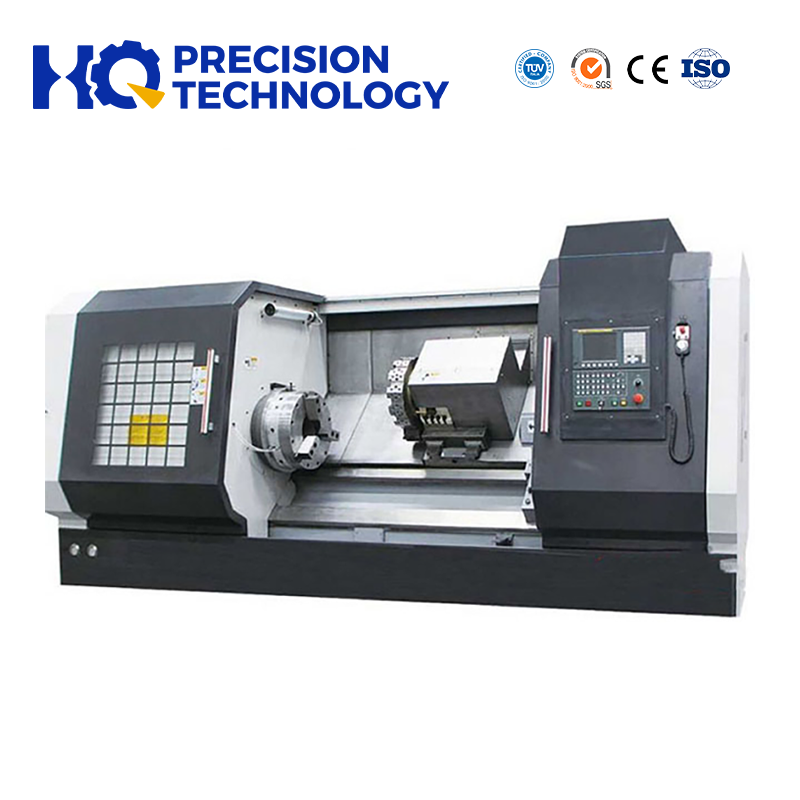
Manual lathes are best suited for small shops or businesses with low-volume production needs. They are ideal for:
One-off custom parts or prototypes.
Smaller production runs or tasks that require frequent adjustments.
Cost-conscious businesses with limited budgets for machinery.
Workshops or hobbyists that require flexibility and manual control over the machining process.
Choosing between a CNC lathe and a manual lathe depends largely on your specific business needs, budget, and production volume. CNC lathes are ideal for high-precision, high-volume operations where speed, consistency, and automation are key. They offer faster production times, higher accuracy, and minimal operator intervention. On the other hand, manual lathes are more affordable and offer greater flexibility for custom projects and small runs.
At Shandong HQ Precision Technology Co., Ltd., we offer both CNC lathes and manual lathes, tailored to suit a wide range of industries and applications. Whether you're looking to streamline your mass production processes or need a versatile machine for custom work, we provide top-quality equipment designed for your success.
Q: What is the main advantage of using a CNC lathe over a manual lathe?
A: The main advantage of a CNC lathe is its ability to perform high-precision machining with minimal human intervention, increasing speed, consistency, and efficiency.
Q: Are CNC lathes suitable for small businesses or are they only for large-scale production?
A: While CNC lathes are ideal for high-volume production, they can also be beneficial for small businesses that require precision and efficiency for custom jobs.
Q: Can manual lathes produce parts with the same precision as CNC lathes?
A: Manual lathes can produce high-quality parts, but they are more prone to human error and may not offer the same level of consistency and precision as CNC lathes.
Q: What types of industries use CNC lathes?
A: CNC lathes are widely used in industries such as aerospace, automotive, medical, and electronics, where precision and repeatability are essential.


