Views: 0 Author: Site Editor Publish Time: 2026-10-26 Origin: Site
Upgrading your machining capabilities is a critical business decision. You must carefully balance heavy capital expenditure against the promise of increased production capacity. Making the wrong equipment choice can stall your manufacturing output and drain your operating budget. While traditional manual lathes have served as the undisputed backbone of turning operations for decades, industry standards are shifting rapidly. The relentless push for tighter tolerances and highly automated workflows drives many modern shops toward computer numerical control (CNC) technology.
This guide breaks down the operational realities, financial structures, and implementation risks of both platforms. We evaluate exactly how each machine performs on a busy shop floor. You will learn practical strategies to optimize your production workflow and minimize costly downtime. By understanding these dynamic variables, you can confidently make an evidence-based procurement decision tailored to your facility.
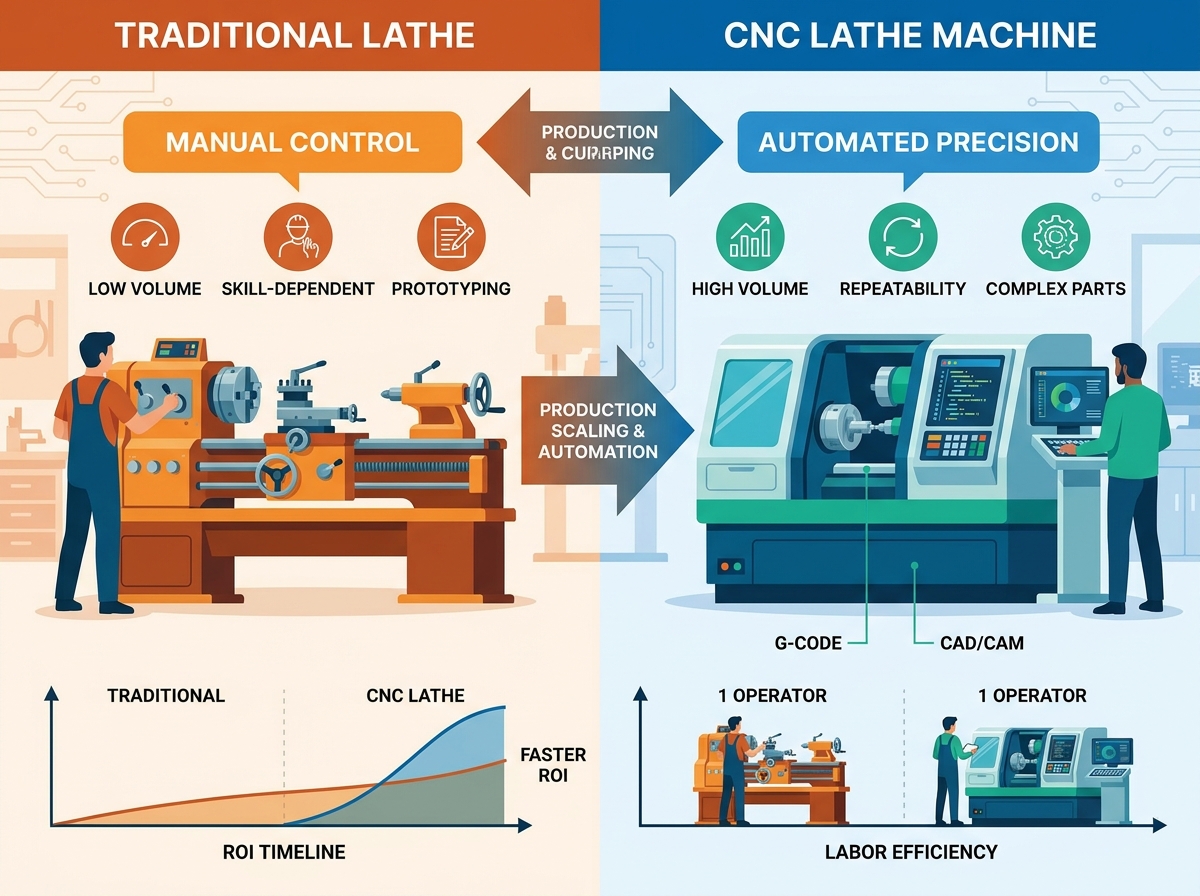
Production Volume: Traditional lathes excel in low-volume, repair, or prototyping scenarios; a CNC Lathe Machine becomes essential when scaling production runs where repeatability is non-negotiable.
Cost vs. ROI: CNC platforms require a significantly higher initial investment, but offset costs long-term through reduced scrap rates, faster cycle times, and multi-machine operation by a single technician.
Quality Control: Precision CNC models eliminate operator fatigue as a variable, ensuring consistent micro-inch tolerances across thousands of parts.
Implementation Reality: Transitioning to CNC requires new software infrastructure (CAD/CAM), staff upskilling, and a rigid maintenance schedule to prevent costly downtime.
The fundamental divide between these two machining platforms lies in how they execute cutting commands. Traditional lathes operate under a manual framework. The machinist physically stands at the equipment. They turn manual handwheels to feed the cutting tool into the workpiece. They read physical dials and digital readouts to gauge cutting depth. This process relies heavily on operator skill and intuition. Machinists often describe this as "by-feel" machining. They can sense tool pressure and adjust feed rates instantly based on material feedback. Because of this direct control, manual machines are best suited for quick, one-off toolroom jobs. You can chuck a piece of steel and begin turning immediately. There is no programming delay. They also excel in maintenance and repair operations where custom, single-part fixes are common.
In contrast, the CNC architecture fundamentally changes the machining process. The workflow shifts away from physical handwheels to digital G-code. A programmer inputs exact coordinates and toolpaths into a computer interface. High-torque servo motors translate these digital commands into precise physical movements. Automated tool turrets swap cutting tools in a fraction of a second. The machine dictates the exact speed and feed rate throughout the entire cycle.
This architectural shift dramatically improves process predictability. You transfer the burden of accuracy from the machinist's physical dexterity to the programmer's upfront setup. Once the program is verified, the machine repeats the exact same motions endlessly. We frequently see shops utilize CNC Lathes to run continuous operations across multiple shifts. Operator fatigue no longer influences part dimensions. You eliminate human error from the actual cutting phase, ensuring every part matches the original CAD model perfectly.
Scaling production runs introduces strict quality compliance challenges. When manufacturing thousands of parts, repeatability becomes your primary concern. A manual operator cannot consistently hold tolerances within a few tenths of a thousandth of an inch over an eight-hour shift. Fatigue inevitably sets in. A Precision CNC Lathe Machine maintains rigid compliance with strict quality inspection frameworks over prolonged runs. The servo motors position the tools perfectly every single time. This ensures you meet the demanding standards required by aerospace, automotive, and medical device sectors.
Part complexity also dictates your equipment choice. Traditional manual turning is generally limited to 2-axis operations (X and Z axes). You can face, turn, drill, and thread basic cylindrical shapes. However, modern manufacturing often demands more complex geometries. Advanced computer-controlled setups offer 3-axis, 4-axis, or live-tooling capabilities. These machines can perform milling, cross-drilling, and tapping operations while the part remains in the turning spindle. You can drop a raw slug of material into the machine and extract a completely finished, complex component. This "done-in-one" capability drastically reduces setup changes. Fewer manual setups mean fewer opportunities for alignment errors.
From the quality inspector's lens, automation fundamentally changes part verification. In a manual shop, the machinist stops the spindle, cleans the part, and measures it using a manual micrometer. This process wastes time and introduces subjective reading errors. Modern automated systems utilize integrated touch probes. These probes drop down and measure the part while it remains in the chuck. If the system detects minor tool wear, it automatically applies wear compensation offsets to the next cycle. This closed-loop feedback system drastically reduces out-of-spec parts.
Table 1: Quality and Complexity Capabilities Comparison
Capability Metric | Traditional Manual Lathe | CNC Turning Center |
|---|---|---|
Tolerance Consistency | Dependent on operator skill and fatigue levels. | Maintains micro-inch precision over long production runs. |
Axis Flexibility | Limited to basic 2-axis turning operations. | Supports multi-axis operations including live tooling. |
Error Correction | Requires manual micrometer checks and dial adjustments. | Utilizes automated touch probes and dynamic wear offsets. |
Setup Efficiency | Requires multiple manual setups for complex parts. | Combines milling and turning into a single setup cycle. |
Procuring new machinery demands a thorough financial analysis. You must evaluate the raw purchase price of the equipment. Traditional manual machines offer a highly attractive entry point. Their mechanical simplicity keeps initial capital expenditure low. Conversely, digital counterparts demand a significantly higher initial investment. Beyond the base iron, you must budget for software licensing, specialized tooling packages, and post-processor configurations. This initial sticker shock often deters smaller job shops.
However, you must analyze labor economics to understand the true return on investment. The manual manufacturing model requires a one-to-one ratio. You need one highly skilled manual machinist dedicated entirely to one machine. Finding these experienced craftsmen is increasingly difficult in today's labor market. Their hourly wages directly impact your cost per part. Automated workflows fundamentally alter this dynamic. A single skilled programmer or operator can monitor two, three, or even four automated machines simultaneously. You effectively multiply your workforce output without hiring additional personnel. This creates the potential for "lights-out" manufacturing, where machines run unattended overnight.
You also achieve substantial savings through material waste reduction and extended tool life. Digital programming utilizes a feature called Constant Surface Speed (CSS). As the cutting tool moves closer to the center of the workpiece, the part diameter decreases. To maintain the optimal cutting condition, the controller automatically increases the spindle RPM. This continuous optimization prevents premature insert chipping. It extends the life of expensive carbide tooling. Furthermore, optimized and predictable feed rates dramatically reduce the number of scrapped parts. When analyzing these operational savings against the higher purchase price, shops typically observe a favorable ROI timeline ranging from 12 to 36 months, depending on production volume.
Transitioning from a manual shop to a digitized manufacturing floor involves substantial implementation risks. The most immediate challenge is the prevailing skills gap. You cannot simply place a manual machinist in front of a computer screen and expect immediate productivity. Staff upskilling is mandatory. Your team must learn complex CAD/CAM software to generate accurate toolpaths. They must understand conversational programming and machine controller interfaces. This training phase often temporarily lowers overall shop productivity before the benefits materialize.
Facility infrastructure also presents unique challenges. Manual machines are relatively forgiving regarding their environment. Digital equipment requires strict environmental controls. You must carefully manage facility temperatures. Even minor temperature fluctuations cause thermal expansion in the machine castings, which destroys tight tolerances. Additionally, you must evaluate your shop foundation. These heavy, high-speed machines require rigid, reinforced concrete pads to absorb cutting vibrations. You must also ensure your electrical grid supplies clean, stable three-phase power.
Finally, maintenance requirements change drastically. When a conventional lathe breaks down, the repair is usually mechanical. Maintenance staff can quickly replace worn drive belts, damaged gears, or faulty bearings. Downtime is generally minimal. Complex automated systems involve delicate sensors, sophisticated encoders, and servo drives. Diagnosing a faulty logic board requires specialized technicians. If a crash occurs on a manual machine, you might break a cutting tool. If a high-speed crash occurs on a computer-controlled unit, you risk destroying an expensive spindle cartridge, leading to weeks of costly downtime.
Selecting the optimal turning platform requires an honest assessment of your current workflow and future growth trajectory. One machine is not objectively better than the other; rather, they serve entirely different business models.
Your primary business consists of custom repair work or low-volume prototyping.
Capital preservation is your immediate corporate priority.
You frequently machine unique, one-off parts that do not justify CAD/CAM programming time.
Your machined parts require simple, straight turning without complex intersecting geometries.
You operate in an environment lacking temperature control or stable three-phase power.
You are experiencing severe production bottlenecks in high-volume, repetitive part orders.
Your contracts require strict, documented adherence to tight tolerances (e.g., aerospace, medical devices).
You need to significantly reduce cycle times by combining turning and milling into a single operation.
You want to maximize your labor output by allowing one operator to run multiple spindles simultaneously.
You intend to implement automated bar feeders for continuous, unattended machining shifts.
Begin your procurement journey by defining specific criteria based on your most problematic parts. Gather your engineering drawings and calculate your current manual cycle times. Reach out to equipment manufacturers to request a tailored machine demonstration. Submit a complex part drawing and request a cycle-time time study. This data will clearly illustrate the potential efficiency gains before you commit to a purchase.
The decision between a traditional manual lathe and an automated turning center fundamentally shapes your manufacturing capabilities. It is not about declaring one machine objectively superior. Instead, it is about aligning your equipment with your shop's production volume, available labor pool, and long-term growth trajectory. Manual machines remain indispensable for bespoke repairs and rapid prototyping. Automated systems provide the scalable efficiency, exacting tolerances, and operational consistency required to compete in modern, high-volume supply chains.
Carefully evaluate your initial capital readiness against the projected timeline for a return on your investment. Review your facility infrastructure and prepare a comprehensive training plan for your staff. We strongly recommend taking proactive steps today. Schedule a consultation with a technical sales engineer. Request a tailored production calculation based on your specific part geometries, or browse current equipment inventory to compare technical specifications firsthand.
A: No. Manual turning skills are still vital for bespoke repairs, quick toolroom fixes, and understanding the physical principles of cutting metal before programming a machine to do it. Experienced manual machinists often make the most effective programmers because they intuitively understand tool pressure and material behavior.
A: Most job shops typically see a full return on investment within 12 to 36 months. This timeline heavily depends on running multiple shifts, significantly reducing material scrap, and successfully acquiring high-volume contracts that were previously impossible to fulfill with manual equipment.
A: Buying used digital equipment carries substantial risks, including hidden servo wear, outdated proprietary control systems, and a complete lack of warranty coverage. A new manual lathe offers guaranteed predictability and simple maintenance. If considering a used automated unit, always mandate a thorough professional inspection before finalizing the purchase.