
Views: 0 Author: Site Editor Publish Time: 2026-03-16 Origin: Site
Aerospace manufacturing demands the highest levels of precision and efficiency. The aerospace industry is one of the most technologically advanced sectors, with strict requirements for the performance, quality, and safety of every component. Components must meet ultra-tight tolerances, often with complex geometries and challenging materials. This makes machining aerospace parts one of the most demanding tasks in manufacturing. To address these challenges, manufacturers rely on state-of-the-art machinery, such as slant lathes for aerospace parts. These machines have become a game-changer in precision turning for the aerospace industry. In this article, we will explore why slant lathes are ideal for aerospace machining, examining their key features, benefits, and real-world applications.
Aerospace parts often involve intricate designs, high-performance materials, and strict safety requirements. As a result, machining these parts presents several challenges.
The precision required in aerospace machining is unmatched in other industries. Parts must meet extremely tight tolerances, often within a range of ±0.001 mm or even tighter. These parts may need to fit into complex systems, such as aircraft engines or landing gear, where even the smallest deviation can lead to failure. For example, a shaft used in an engine must fit perfectly with other components to ensure proper function and avoid safety risks.
Many aerospace components are made from advanced materials like titanium, Inconel, and high-strength aluminum alloys. These materials are crucial for the performance of the aircraft, but they also pose significant challenges during machining. Titanium, for instance, is tough to cut, and its low thermal conductivity means that heat builds up quickly, potentially damaging tools and the workpiece. Inconel is another challenging material, known for its ability to withstand extreme temperatures. Machining these materials requires high cutting forces, precise control, and advanced machinery that can handle the heat and pressure generated during the process.
Aerospace manufacturers must adhere to rigorous quality and certification standards, such as ISO 9001 and AS9100. These certifications ensure that parts meet both industry regulations and customer expectations. Aerospace components must undergo extensive testing, including mechanical testing, stress testing, and performance verification, before they are deemed suitable for use. Slant lathes, with their precision and reliability, are critical to meeting these stringent quality standards.
Some of the most commonly machined aerospace components include:
Shafts: Engine shafts, turbine shafts, and other rotating components must be manufactured with high precision to ensure proper operation in high-stress environments.
Bushings: Used in bearing and support systems, bushings need to be machined with tight tolerances to ensure smooth operation and reduce wear over time.
Threaded Parts: Fasteners, bolts, and nuts used in aerospace applications must have precise threads to ensure secure and safe connections.
Structural Components: Aircraft wings, fuselages, and other structural parts require precise machining to maintain structural integrity and ensure safety.
A slant lathe is a type of CNC lathe that features a bed that is slanted or angled. This unique design offers several key advantages over traditional flat-bed lathes, especially when it comes to machining aerospace parts.
Gravity-Assisted Chip Evacuation: The slanted bed allows gravity to naturally assist in the removal of chips and debris during machining. This helps to reduce the chances of chips re-entering the cutting area, which can cause defects, scratches, and contamination on the workpiece. Efficient chip evacuation is particularly important when machining tough materials like titanium and Inconel, which tend to produce a significant amount of debris.
Enhanced Rigidity and Vibration Damping: The slanted bed design improves the machine's overall rigidity, making it more stable during high-speed cutting. Reduced vibrations lead to a more consistent cutting process, which directly improves the quality of the finished product. This is particularly important when machining aerospace components that require tight tolerances and superior surface finishes.
Improved Access and Ergonomics: The slanted bed also provides better accessibility for operators, allowing them to work more efficiently and safely. This improved ergonomics makes setup and adjustments easier, reducing the time required to prepare the machine for production.
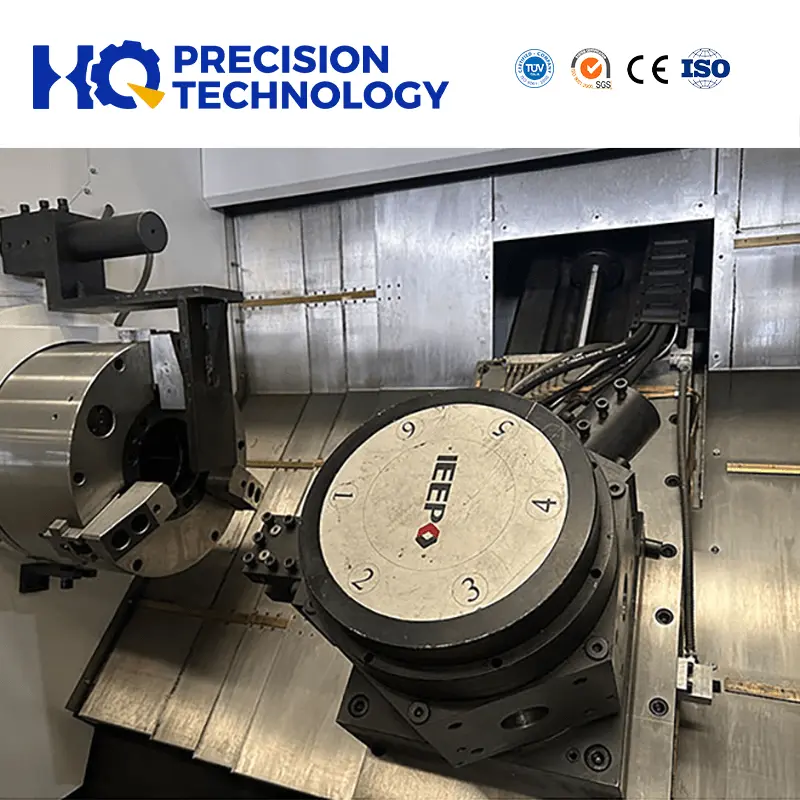
The unique design of slant lathes offers several advantages that are particularly beneficial for aerospace machining, where precision, efficiency, and quality are critical.
One of the most important factors in aerospace machining is achieving a high-quality surface finish. Aerospace parts must not only meet dimensional accuracy requirements but also have smooth surfaces to ensure proper fit and function. Slant lathes help to achieve superior surface finishes thanks to their stable cutting process and enhanced rigidity. This reduces the need for secondary finishing processes such as polishing, which can add time and cost to production.
Slant lathes provide exceptional precision, making them ideal for parts that require tight dimensional tolerances. For example, when machining a component like a turbine shaft, the slant lathe ensures that every dimension is within the specified limits, ensuring the part fits correctly with other components and functions as intended. This precision is critical in aerospace, where even small deviations can result in part failure.
Aerospace parts are often machined at high speeds to improve productivity and reduce cycle times. The stability provided by the slant lathe’s design allows for high-speed machining without sacrificing accuracy. This is particularly beneficial when producing high volumes of parts or when working with materials that require faster cutting speeds to avoid heat buildup and material degradation.
The benefits of slant lathes extend beyond just improved machining performance. They also help to streamline the entire production process by offering:
Reduced Need for Secondary Finishing: With better surface finishes and tight dimensional control, parts often require less post-machining work, reducing the overall time and cost of production.
Fewer Rejects and Rework: The precision and stability of slant lathes lead to fewer defects and rejected parts, ultimately improving overall manufacturing efficiency.
To better understand the advantages of slant lathes, it is useful to compare them to other types of lathes commonly used in the aerospace industry.
Comparison of Slant Lathe vs. Flat Bed & Conventional Lathes
Feature | Slant Lathe | Flat Bed Lathe | Manual Lathe |
Precision | ⭐⭐⭐⭐ | ⭐⭐⭐ | ⭐⭐ |
Chip Evacuation | Excellent | Moderate | Poor |
Aerospace Suitability | High | Medium | Low |
Automation Friendly | Yes | Yes/No | No |
As seen in the table, slant lathes outperform traditional flat-bed and manual lathes in nearly every category that is essential for aerospace machining. Their enhanced precision, efficient chip evacuation, and ability to handle high-speed cutting make them the ideal choice for aerospace applications.
Slant lathes have been successfully implemented in a variety of aerospace applications. Some real-world use cases include:
Engine Shafts: These critical components require precise machining to ensure proper fit and function within the engine.
Landing Gear Components: With high-stress loads, these parts must be manufactured to strict tolerances and surface finish requirements.
Structural Parts: The structural integrity of an aircraft relies heavily on the accuracy of the parts that form its framework. Slant lathes help produce these parts with the required precision.
Using slant lathes for aerospace machining has resulted in significant reductions in cycle times and improvements in part quality. This enables manufacturers to meet tight production deadlines while maintaining the high standards required in the aerospace industry.
In conclusion, slant lathes for aerospace parts are essential for achieving the high precision, efficiency, and quality required in the aerospace industry. The unique advantages of slant lathes, such as enhanced chip evacuation, improved rigidity, and better surface finishes, make them the perfect solution for precision turning of aerospace components. For manufacturers looking to improve their machining processes, slant lathes provide a reliable and effective tool to meet the challenges of aerospace production.
At HQ Precision Technology, we offer a range of high-quality slant lathes designed specifically for aerospace applications. Contact us today to learn more about our precision machining solutions and how they can benefit your production process.
1. What is the advantage of using a slant lathe in aerospace machining?
Slant lathes offer better chip removal, enhanced rigidity, and superior surface finishes, which are critical for machining aerospace parts to the required precision.
2. Can slant lathes handle high-speed machining?
Yes, slant lathes are designed for stable cutting at high speeds, making them ideal for high-volume aerospace part production.
3. How does the slant bed design improve machining efficiency?
The slant bed design allows for gravity-assisted chip evacuation, which minimizes downtime for cleaning and enhances overall machining efficiency.
4. What types of aerospace components are typically machined using slant lathes?
Slant lathes are ideal for machining engine shafts, landing gear components, threaded parts, and structural parts for the aerospace industry.


