
Views: 0 Author: Site Editor Publish Time: 2026-03-23 Origin: Site
The automotive industry has seen continuous advancements in technology, with turbochargers playing a crucial role in improving engine performance, efficiency, and overall driving experience. As demand for high-performance turbochargers increases, the pressure is on manufacturers to produce these components with the utmost precision and efficiency. However, machining turbocharger parts presents its own set of challenges, particularly in achieving the required tolerances and handling the tough materials typically used. This is where automotive turbocharger slant lathes come into play. These lathes offer significant advantages in terms of precision, stability, and productivity, making them an ideal solution for machining turbocharger components. In this article, we will explore how slant lathes improve automotive turbocharger production, highlighting their key benefits and real-world applications.
A turbocharger is a key component in many modern internal combustion engines, designed to improve engine efficiency by forcing more air into the combustion chamber. This increased air supply allows for more fuel to be burned, resulting in higher power output. However, turbochargers are highly complex components that require precise machining to ensure their performance and durability.
A typical turbocharger consists of several critical components that need to be machined with high precision:
Compressor: The compressor is responsible for compressing the incoming air, increasing its density before it enters the combustion chamber.
Turbine: The turbine is driven by exhaust gases from the engine and is connected to the compressor via a shaft.
Shaft: The shaft connects the turbine and the compressor, transmitting mechanical power between the two components.
Bearing Housings: These housings support the shaft and ensure smooth rotation of the turbine and compressor.
Each of these components plays a vital role in the functioning of the turbocharger, and any deviation in their dimensions or quality can significantly impact engine performance.
Turbochargers are typically made from high-performance materials such as Inconel, a nickel-chromium-based superalloy, and stainless steel. These materials are specifically chosen for their ability to withstand extreme temperatures and mechanical stresses. However, they are also notoriously difficult to machine due to their hardness and resistance to wear. Achieving the necessary tolerances, especially for rotating components such as shafts and bearings, requires precise and stable machining processes.
The challenge lies in producing turbocharger components with the required tolerances and surface finishes while maintaining the integrity of the materials used. Any minor defect, such as a slight misalignment or surface imperfection, could lead to issues like imbalance, excessive wear, or even failure of the turbocharger.
Some of the key turbocharger components that are typically machined using slant lathes include:
Compressor Shaft: The shaft needs to be machined to high precision to ensure it rotates smoothly and efficiently, with minimal vibration.
Turbine Shaft: Similar to the compressor shaft, the turbine shaft must also be precisely machined to maintain balance and prevent failures.
Bearing Housings: These parts must be manufactured with tight tolerances to ensure they properly house the bearings and allow for smooth rotation of the turbine and compressor.
Slant lathes offer several advantages when it comes to machining turbocharger components, especially considering the challenges of material hardness and tight tolerances.
One of the main benefits of slant lathes is their ability to evacuate chips efficiently. The slanted bed design allows gravity to assist in removing chips during machining, reducing the risk of chips re-entering the cutting area and damaging the part or tooling. In high-speed cutting operations, especially when machining hard materials like Inconel or stainless steel, efficient chip removal is crucial to prevent overheating and ensure the production of high-quality parts.
Turbocharger components, particularly the rotating shafts, require machining at high speeds to achieve the desired surface finish and dimensional accuracy. Slant lathes provide superior stability during high-speed cutting, reducing vibrations and ensuring smooth operation even at high revolutions per minute (RPM). This stability is essential when machining rotating components like shafts, as any imbalance can result in reduced turbocharger efficiency and longevity.
When machining components that will rotate at high speeds, such as turbine and compressor shafts, achieving precise balance is critical. Slant lathes provide exceptional precision control, ensuring that these components are machined to exact specifications. Even the slightest imbalance can lead to vibrations, increased wear, or failure, making it essential for manufacturers to use machines that offer high accuracy in cutting. Slant lathes, with their rigid design and ability to perform high-speed machining, make it easier to achieve the necessary balance and dimensional accuracy.
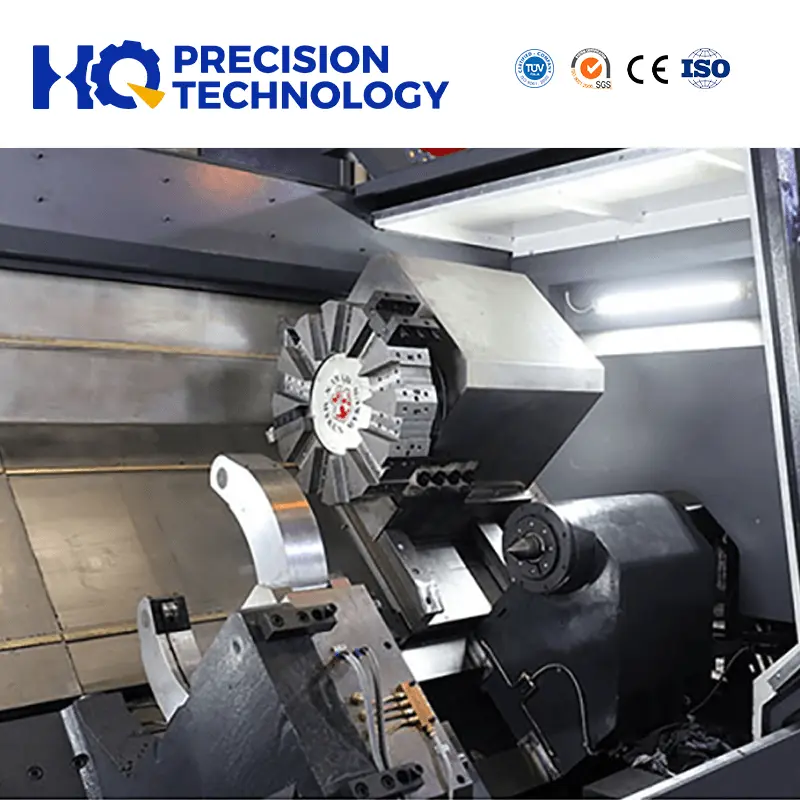
In the automotive industry, where manufacturers face tight deadlines and high production volumes, speed and productivity are crucial. Slant lathes offer significant productivity advantages over other lathe types, particularly in terms of cycle time and part quality.
Slant lathes are known for their ability to handle high-speed cutting efficiently, leading to shorter cycle times. The slanted bed design allows for quicker chip removal, while the machine's rigidity reduces the time spent on setup and adjustments. Compared to traditional flat-bed lathes, slant lathes are more efficient in producing turbocharger parts, reducing the overall time required for each part and increasing the throughput.
This productivity advantage is particularly important for automotive manufacturers, who must meet high demands for turbochargers while maintaining quality and precision.
The following table outlines a typical production setup when machining turbocharger components on a slant lathe. This example illustrates the features and tolerances that are critical for producing high-quality turbocharger parts.
Turbocharger Slant Lathe Production Setup
Part | Feature | Typical Tolerance |
Compressor Shaft | Radial runout | <0.01 mm |
Turbine Housing | Bore precision | <0.02 mm |
Threaded Elements | Thread accuracy | Class 4 |
Each part of the turbocharger requires specific features and tolerances to ensure proper fit and performance. The slant lathe allows manufacturers to achieve these tolerances with high precision, ensuring that the components function as intended when assembled into the turbocharger.
Automotive original equipment manufacturers (OEMs) are under constant pressure to improve performance, reduce costs, and meet regulatory standards. Using slant lathes to machine turbocharger components offers several real-world benefits that directly impact OEMs' bottom lines.
By providing superior precision, slant lathes reduce the likelihood of defects and scrap during the machining process. The ability to achieve tight tolerances and smooth finishes reduces the need for rework and ensures that more parts meet quality standards on the first pass. This not only helps manufacturers save time and money but also leads to higher overall product quality.
Increased consistency in part quality also means fewer failures in the field, which is crucial for turbocharger manufacturers who must meet performance and reliability standards in the automotive industry.
In conclusion, automotive turbocharger slant lathes are a valuable tool for improving the precision, efficiency, and productivity of turbocharger production. The benefits of using slant lathes for machining turbocharger components, such as improved chip removal, stable high-speed cutting, and enhanced precision, make them the ideal choice for automotive manufacturers. By reducing cycle times, improving consistency, and ensuring high-quality results, slant lathes play a key role in meeting the demands of the automotive industry.
At HQ Precision Technology, we offer state-of-the-art slant lathes designed for high-precision automotive machining. Our solutions are tailored to meet the specific needs of turbocharger manufacturers and help them achieve the highest levels of quality and performance. Contact us today to learn more about how our CNC lathes can improve your production process.
1. How do slant lathes improve turbocharger production?
Slant lathes provide enhanced precision, better chip removal, and stability during high-speed machining, which are crucial for producing high-quality turbocharger components.
2. What types of turbocharger components are machined using slant lathes?
Key components such as compressor shafts, turbine shafts, and bearing housings are typically machined using slant lathes due to their ability to achieve tight tolerances and smooth finishes.
3. What is the typical tolerance for machining turbocharger parts?
Turbocharger parts, such as compressor shafts and turbine housings, require tolerances as tight as 0.01 mm for radial runout and 0.02 mm for bore precision.
4. How do slant lathes help automotive OEMs?
Slant lathes reduce scrap, improve consistency, and increase productivity, helping OEMs meet tight deadlines while maintaining the required quality and performance standards.


